Minor League history: Oswego Netherlands
A special piece of Minor League history today. Since this is a blog, mainly about Dutch baseball, the club in today’s limelight is a perfect fit for this blog: the Oswego Netherlands of the Canadian-American League.
The Oswego Netherlands was named after the local Netherlands Milk and Ice Cream Company. The team was one of the charter members of the Canadian-American League in 1936. In its first season, the team finished dead last with a 32-51-3 record. As one of the first teams, the club installed a lighting system.
Perhaps the most famous player that joined the ranks of the Oswego Netherlands was Bob Lemon, who then played as a shortstop and who was the offensive threat of the club with a .312/.372/.450 slash line. With the Cleveland Indians, the club the Netherlands was affiliated to in 1937 and 1938, Lemon learned to pitch and became one of the top pitchers in the post-WW II ERA.
In its second season, the team finished second with a 67-40 record, trailing the Perth-Cornwall Greys by 2.5 games, but in the playoffs, the team would be ousted in the first round by the fourth place Ogdensburg Colts who beat them 3-1.
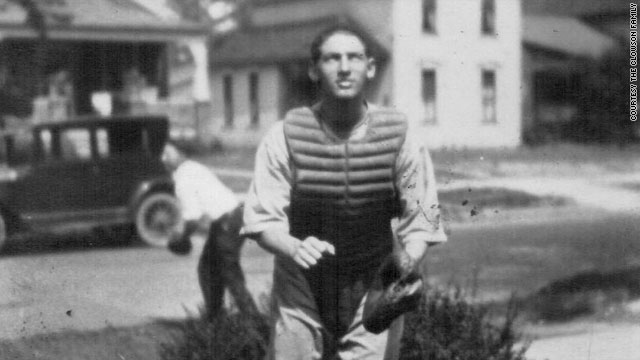
In 1937, a certain Alex Clowson played with the Oswego Netherlands and batted .320. Why would a career minor leaguer get a special mention? Well, Clowson owned a tavern after his baseball career and in this tavern, he met the late owner of the Yankees, George Steinbrenner. According to Steinbrenner, Clowson taught him everything he knew about baseball. Being a second airforce lieutenant, Steinbrenner never ordered an alcoholic beverage. He would come in and order a Coke with a cherry in it. And he would sit there and would talk about baseball with Clowson for hours on end.
In 1938, the Netherlands did not come close to contention as the finished in sixth place with a 54-69 record, trailing the league-leading Amsterdam Rugmakers by 27 games.
Despite the crappy season, Mike Naymick stood out as he led the league with 230 strikeouts. He also would join the Cleveland Indians. In comparison with Lemon, Naymick’s MLB career didn’t last as long. In 1939, he debuted with the Indians. In the following years, he would play parts of three seasons with the Indians and in 1944 he was traded to the Cardinals. Where many served in the military in those years, Naymick was turned down for the military service due to his shoe size (15 US/ size 49 in Europe).
Next to being affiliated with the Cleveland Indians and the Washington Senators (1939), the club was also affiliated to the Buffalo Bisons of the International League in 1936.
In its five years of existence, the club never drew many fans. In 1938, attendance fell to only 16,522 for the season, the second worst in the league. As a result of the poor attendance, the city of Oswego sold the lighting system after the 1939 season.
According to Amsterdam Rugmakers traveling secretary Spencer Fitzgerald, the Netherlands didn’t even enough money to buy balls.
In the 1939 season, the Oswego Netherlands would make the playoffs once more as it finished in second place with a 69-53 record, trailing the Amsterdam Rugmakers by twelve games. The club had two twenty-game winners in Kenneth Taskian and Harry Kuntashian. But also this season, the club would be ousted in the first round.
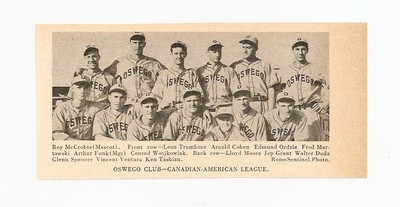
The 1940 season, the club was out of contention early in the season and finished in sixth place, five games below .500 (58-63). As a result, the club was sold after the season. The club was moved to Pittsfield MA where it would play as the Electrics.